Hello, all!
Firstly, I would love to sincerely thank you for reading the most recent blogs on Daniel Day-Lewis & Peter Sellers - two performers, as mentioned there, who I fervently look up to in performance. It is certainly not limited to those two, however; the list of those who have influenced me in performance would resemble a realistic, Christopher Nolan-esque portrayal of Santa Claus' list of 2+ billion children asking for presents. LITERALLY. THERE HAVE BEEN 2 BILLION+ PERFORMERS WHO HAVE, IN FACT, INFLUENCED MY OWN PERFORMANCE STYLE. WRAP YOUR HEAD AROUND IT, TIE IT USING WHICHEVER KNOT YOU PREFER TO TIE YOUR SHOES WITH, AND GO "Ah!...." LIKE YOU PROBABLY DO AFTER CONTENTEDLY TYING YOUR SHOES.
I'm sorry for taking that dark turn so drastically. ANYwho, back to my point.
The list of those who have influenced me to this point in my life would be too long and too cumbersome for a reader of a blog. Instead, I will dedicate future posts to each of these performers individually in an undecided time "down the line." (<-- By the way, why not "down the parabola"? Or "down the line segment"? Geometric paradoxes worthy of a Joseph Gordon-Levitt tutorial to Ellen Page in "Inception"!)
This post, however, was meant more for a check-in. I have certainly not forgotten about "BirdieNumNuMilkshake," and, in fact, it's quite the opposite: I've been racking my brain consistently for the past week in desperation trying to think of something topical to write about. And then, in an unexpectedly poignant turn, I became introspective and realized: I don't NEED to write about a given topic (I ALSO have read a frightening amount of blogs in the past week or so and realized that the overall purpose of having a blog is to really not have an agenda, or plan.)
Newtown, Connecticut Shootings & Our Duties as Citizens
It's been an oddly satisfying week this week; finals are finished, I'm preparing for an acting competition in the coming weeks, and to be home is a God-sent reprieve from the world and all of its sometimes stressful intricacies. But, there is one thing that I have decided I want to address, and that is the internationally reported and sensitively discussed shooting in Newtown, Connecticut inside of Sandy Hook Elementary School....
Simply, and somewhat superficially, it's heinous, and unspeakably horrifying. "The massacre of twenty children between the ages 5-10 is an idea and practice reserved for dictatorial countries, and those territories more tribal than our own" is an idea popularly believed and accepted in America. But, the horrifying truth is that democracy, while an internationally accepted norm for ruling, is unspeakably dangerous as far as the ownership and handling of not only handguns, but large assault rifles - like the one used primarily by the alleged shooter in Newtown. And, while I am absolutely not arguing against the Constitution or democracy as an institution reflecting the beliefs of our founding fathers. What it is I am arguing is that, while democracy is dangerous in the aforementioned regard, it is also the saving grace, because it affords us the ability to re-open discussions on sensitive topics such as "gun control" and the rights of the mentally disabled. As citizens who have, in recent history, taken pride in being firmly nationalistic, we as American citizens need to re-discover what it means to be nationalistic - by informing ourselves on national issues such as this, educating ourselves on the representatives both locally and nationally who find common ground with our own beliefs, and VOTING accordingly. Participation is an integral seam in the American fabric - the one that binds and holds together. I will not advocate for one side or the other on here, for it is not my place to do so.
But, what I will advocate for is for you who are reading to do your duty as socially-conscious citizens of the country - Educate, Vote, and BE HONEST with yourself. Assess and become introspective; find what it is at YOUR core YOU believe, and act upon those feelings.
Thank you for reading you all, and so ends the most serious post of "BirdieNumNuMilkshake"! I hope you're all having a wonderfully peaceful holiday break, and a very HAPPY HOLIDAYS to you all!
Twitter: Chris_0Reilly
--Chris--
Monday, December 17, 2012

Tuesday, December 11, 2012
Peter Sellers & Daniel Day-Lewis - A Final Reflection
Hello yet again, you guys!
We have come to the end of the English 3210: Advanced Composition writing project, and what a journey it has been! In completing the project, I've come to admire the two men mentioned in the title even more than I did previous to this project's inception, and I've certainly grown as a blog author. And, it is because of this growth that I have decided to continue with blogging even after the completion of this project.
In the rubric I created for myself, I said with confidence that, as the final piece of my project, I will provide a detailed juxtaposition of the careers and styles of the two men I have chosen to profile, so as to gain further insight into the "different types/branches" of method acting. However, after extensively writing for three weeks now, I have decided this is not something that can be done. What can be done, however, is to make an assertion about method acting and its seeming "Genre-Specific" style: It is not genre-specific. In fact, method acting, like most other styles, is largely indifferent.
Peter Sellers and Daniel Day-Lewis, for all of their artistic differences in genre focus, are largely similar actors. Each man refused, more often than not, to be referred to the character name during film shooting on and off set. Both men created voices from their own, giving an individuality and uniqueness to each role. Peter Sellers was once quoted as saying, "I used to have a 'real me,' but I had it surgically removed." But, most importantly, each man found the art in entertainment while still remaining entertaining. The "method" is something that, while sounding official and legitimate to tell people that it is something you might be studying, is a mere tool to help actors prepare for roles.
Some actors - like Dustin Hoffman and Robert De Niro - can be as intensely in character as both of these men while the cameras are on; however, once they've turned off, they have their own personality and "character" that they revert back to. In the world of acting and performance, this is widely known as "having an off switch." Actors like Dustin Hoffman and Robert De Niro, while brilliant, have the ability to turn "ON" and "OFF" whenever they please. With this being said, however, they (and most performers) do have idiosyncrasies and practices that help them get "in character"; for example, to prepare for the movie "MARATHON MAN" (1976) in which Dustin Hoffman plays a marathon runner, he began to train and prepare for the role by running. Whilst filming, during each take that called for him to be "out of breath due to running," he would run before each take, so as to help him settle into the mindset that he was a runner who was winded from having just come from a jog. Robert De Niro, similarly, to prepare for his role as a taxi driver in the film "TAXI DRIVER" (1976), he undertook the rigorous night job of a New York City taxi driver to gain insight into the intellect, struggles and triumphs one might experience.
While this is excellent and works for performers like De Niro and Hoffman, some men - Daniel Day-Lewis and Peter Sellers - are absolute perfectionists by nature, and cannot resort to this. They would be the students who would not turn in their research paper until the very last possible second, meticulously combing each page for any mistake, and eventually turning it in still not completely satisfied. It is because of their natural perfectionist dispositions that each dedicates (and dedicated) himself fully to a role. Each might have idiosyncrasies in order to prepare for a take, too, but it wouldn't be the actor's own idiosyncrasies; these would be character-motivated idiosyncrasies, or something the character would do to prepare for what ever the following scene's theme might be.
Put simply, the "method" is a tool to help get in a believable mindset for the audiences who will be viewing. This desire for a "believable mindset" should be the end-goal for any performer; if you do not believe in what you are doing, how is the audience expected to? Peter Sellers and Daniel Day-Lewis used this technique to both bolster the comedic value and intensify the dramatic value of each actor's respective films. Both techniques described (Hoffman & De Niro vs. Sellers & Day-Lewis) are widely respected and recognized, but the work of Day-Lewis often stands out because of the extra mile each has been known and was known to go. Every performer is individual and different, and ultimately, it is up to them to decide what works and what does not.
Thank you guys for reading through my project - I can't tell you how much I appreciated it. Below I will list the sources I consulted for the past posts concerning Peter Sellers & Daniel Day-Lewis:
(1.) "Mr. Strangelove: A Biography of Peter Sellers" -- by Ed Sikov
(2.) "Peter Sellers: The Authorized Biography" -- Alexander Walker
(3.) "An Actor Prepares" -- Constantin Stanislavski
(4.) http://movies.yahoo.com/blogs/movie-talk/abraham-lincoln-surprising-strength-220542759.html
"Abraham Lincoln's Surprising Strength" -- Vera H.C. Chan
(5.) https://www.youtube.com/watch?v=BERKF9rnBcQ <-- "Lincoln Q&A: Full Interview (2012) with Steven Spielberg & Daniel Day-Lewis" -- Conducted by journalist Mark Harris (Entertainment Weekly)
NEXT UP!
Goodness, audience, you guys are chomping at the bit!... And I don't blame you. Just kidding.
I haven't decided what'll be coming next, but I do imagine there will be a bit of a break between now and my next post... as mentioned previously, I have my first ever scholarship audition coming up in about a month for the Kennedy Center of Performing Arts, based in Washington D.C. I'll be going to Saginaw Valley State University in Michigan for my regional audition, and on the very off-chance I were to advance, I would go to Washington, D.C. in April for nationals. I'll be busy prepping during the next couple weeks, but I'll probably stop in and say hey and give updates out for absolute free!
As always, you guys, I can't thank you enough for reading! I will certainly write soon.
Twitter: Chris_0Reilly
All of the best,
Chris O'Reilly
We have come to the end of the English 3210: Advanced Composition writing project, and what a journey it has been! In completing the project, I've come to admire the two men mentioned in the title even more than I did previous to this project's inception, and I've certainly grown as a blog author. And, it is because of this growth that I have decided to continue with blogging even after the completion of this project.
In the rubric I created for myself, I said with confidence that, as the final piece of my project, I will provide a detailed juxtaposition of the careers and styles of the two men I have chosen to profile, so as to gain further insight into the "different types/branches" of method acting. However, after extensively writing for three weeks now, I have decided this is not something that can be done. What can be done, however, is to make an assertion about method acting and its seeming "Genre-Specific" style: It is not genre-specific. In fact, method acting, like most other styles, is largely indifferent.
Peter Sellers and Daniel Day-Lewis, for all of their artistic differences in genre focus, are largely similar actors. Each man refused, more often than not, to be referred to the character name during film shooting on and off set. Both men created voices from their own, giving an individuality and uniqueness to each role. Peter Sellers was once quoted as saying, "I used to have a 'real me,' but I had it surgically removed." But, most importantly, each man found the art in entertainment while still remaining entertaining. The "method" is something that, while sounding official and legitimate to tell people that it is something you might be studying, is a mere tool to help actors prepare for roles.
 |
| De Niro in "Taxi Driver" |
 |
| Hoffman in "Marathon Man" |
While this is excellent and works for performers like De Niro and Hoffman, some men - Daniel Day-Lewis and Peter Sellers - are absolute perfectionists by nature, and cannot resort to this. They would be the students who would not turn in their research paper until the very last possible second, meticulously combing each page for any mistake, and eventually turning it in still not completely satisfied. It is because of their natural perfectionist dispositions that each dedicates (and dedicated) himself fully to a role. Each might have idiosyncrasies in order to prepare for a take, too, but it wouldn't be the actor's own idiosyncrasies; these would be character-motivated idiosyncrasies, or something the character would do to prepare for what ever the following scene's theme might be.
Put simply, the "method" is a tool to help get in a believable mindset for the audiences who will be viewing. This desire for a "believable mindset" should be the end-goal for any performer; if you do not believe in what you are doing, how is the audience expected to? Peter Sellers and Daniel Day-Lewis used this technique to both bolster the comedic value and intensify the dramatic value of each actor's respective films. Both techniques described (Hoffman & De Niro vs. Sellers & Day-Lewis) are widely respected and recognized, but the work of Day-Lewis often stands out because of the extra mile each has been known and was known to go. Every performer is individual and different, and ultimately, it is up to them to decide what works and what does not.
Thank you guys for reading through my project - I can't tell you how much I appreciated it. Below I will list the sources I consulted for the past posts concerning Peter Sellers & Daniel Day-Lewis:
(1.) "Mr. Strangelove: A Biography of Peter Sellers" -- by Ed Sikov
(2.) "Peter Sellers: The Authorized Biography" -- Alexander Walker
(3.) "An Actor Prepares" -- Constantin Stanislavski
(4.) http://movies.yahoo.com/blogs/movie-talk/abraham-lincoln-surprising-strength-220542759.html
"Abraham Lincoln's Surprising Strength" -- Vera H.C. Chan
(5.) https://www.youtube.com/watch?v=BERKF9rnBcQ <-- "Lincoln Q&A: Full Interview (2012) with Steven Spielberg & Daniel Day-Lewis" -- Conducted by journalist Mark Harris (Entertainment Weekly)
NEXT UP!
Goodness, audience, you guys are chomping at the bit!... And I don't blame you. Just kidding.
I haven't decided what'll be coming next, but I do imagine there will be a bit of a break between now and my next post... as mentioned previously, I have my first ever scholarship audition coming up in about a month for the Kennedy Center of Performing Arts, based in Washington D.C. I'll be going to Saginaw Valley State University in Michigan for my regional audition, and on the very off-chance I were to advance, I would go to Washington, D.C. in April for nationals. I'll be busy prepping during the next couple weeks, but I'll probably stop in and say hey and give updates out for absolute free!
As always, you guys, I can't thank you enough for reading! I will certainly write soon.
Twitter: Chris_0Reilly
All of the best,
Chris O'Reilly
Abraham Lincoln - A Man Who Was Human
Hello, everybody! For the second time in two days, I am writing to you on "BirdieNumNuMilkshake" in order to fulfill the void of happiness in each and every one of your lives. (Also, I have a strict deadline to meet for my English professor, but those details are mere semantics). In today's post, I will be writing about one of my very favorite characters Daniel Day-Lewis has portrayed in his world renown film career: the 16th President of the United States Abraham Lincoln in "LINCOLN" (2012). And, as with yesterday's post on "THERE WILL BE BLOOD" (2007), I will provide context, and the reason why I have chosen such a niche topic.
To end our 2012 Fall Semester in my English 3210: Advanced Composition class, my classmates and I were tasked with completing a lengthy writing assignment of our choosing. It was favorably vague so as to give us, as students, more independence in choosing a topic that we might enjoy. I decided to focus on film, as this is a topic that stands out amongst others as one that I am passionate about. And, because I am a performer myself, there are actors that I look up to and admire greatly; chiefly amongst these are Daniel Day-Lewis (contemporary dramatic actor) and Peter Sellers (British comedic actor from 1950's-1970's). In completing yesterday's post on "There Will Be Blood," I am now nearly complete with this writing assignment. For each performer, I ultimately decided to complete a brief biography, movie reviews of my favorite film of each of theirs, and brief character analyses of my favorite characters each has portrayed throughout his respective career. So, as I said, with this, I am nearing the end, and could not be more torn up about it.
I will begin with "LINCOLN" (2012), and Daniel Day-Lewis' portrayal of our enigmatic, deified 16th President of the United States: Abraham Lincoln. [[SEE TRAILER BELOW]]
Abraham Lincoln: A Man Conflicted
In articles read from all over the critical spectrum on Steven Spielberg's passion project "Lincoln," one detail emerges as both consistent and ultimately noteworthy: Abraham Lincoln, although deified by the greater American population, was an ordinary man. He came from humble beginnings in Kentucky, and eventually moved on to Illinois - a Midwestern state known more for it's citizens' mild manners than any sort of glamor or excitement. Abraham Lincoln was no different, and Daniel Day-Lewis gives a portrayal worthy of those ordinary citizens.
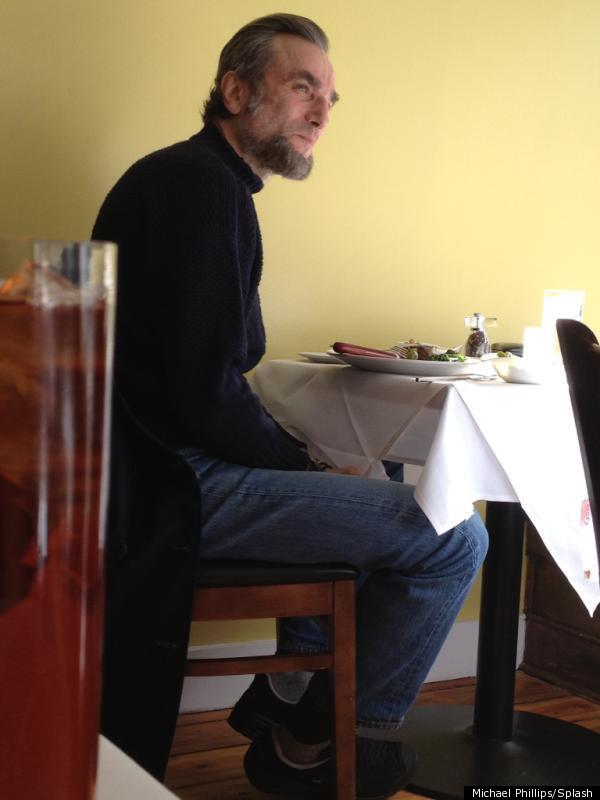 |
| Contemporary Doppleganger |
Day-Lewis fulfilled his duties as "Actor-Playing-Lincoln" in these regards.
With all of this said, the single most important factor for the more accurate, human portrayal was Day-Lewis' vocal intonation. Historical scholars of the Lincoln era and personal Lincoln biographers have all consistently noted that "Abe" did not have a low, baritone/bass pitch to his voice, as is so often portrayed (the 'Hall of Presidents' at Disney World is the #1 culprit here, gang); rather, he had a rather high tenor voice that, according to Steven Spielberg, "Helped his voice to carry when giving speeches in public immensely." Daniel Day-Lewis' voice, much like Jim Carrey's face, is "clay-like": it can shift and eventually form into whatever the appropriate performer wants. His voice, while the appropriate pitch, was also a perfected Midwestern accent, and Spielberg told a story that, while in the preliminary stages of filming, he received a package from Daniel Day-Lewis with a skull and crossbones roughly sketched on the outside facade of the packaging. Inside the package was a tape recorder with a note that said "What do you think?" Spielberg played it, and the voice on the other end was what would become the voice Daniel Day-Lewis would speak in throughout the entire eight month shooting period; said Spielberg, "I felt I was listening to our President."
 |
| JGL as Robert Lincoln w/ Daniel Day-Lewis |
As mentioned previously, Day-Lewis never broke character throughout the roughly eight months spent shooting the film; Steven Spielberg referred to him as "Mr. President" on the set; in an interview with Entertainment Weekly, Joseph Gordon-Levitt said he never truly met Daniel until the wrap party, where he was as soft-spoken, approachable, and genuine over a glass of Guinness as the man he had just finished portraying.
In all, I felt as if though "LINCOLN" (2012) was masterfully done. But, more specifically, Daniel Day-Lewis' portrayal of Abraham Lincoln was sincere, earnest, and human; for the first time in 150+ years, we as the audience were given unprecedented access into the life of an American hero, and that access turned out to be more normal and down-to-earth than one might have previously thought possible.
WHAT comes next?
Well, you guys, with this post, I have all but completed the assignment at hand. There is one more I must complete, and I'll be briefly comparing the two careers and styles of Peter Sellers and Daniel Day-Lewis, giving my argument for why "method" acting is not genre-exclusive.
As always, thank you all so very much for taking time to read this. I welcome any comments below, and I do hope you've enjoyed what you have read so far.
Twitter: Chris_0Reilly
All of the Best,
Chris
Monday, December 10, 2012
"THERE WILL BE BLOOD" (2007) Full Review
Hello, all! In writing for the first time in six days, I owe you all an explanation for my reckless absence.
Eh. Okay. Well, it's been a crazy week of finals and final papers at Marquette University up in Milwaukee for the majority of students here, and my personal academic life is certainly no exception. IN addition to all of the finals mayhem, I am preparing for a scholarship audition I have this upcoming January for the Kennedy Center (The national government's Performing Arts nucleus) in Washington, D.C. SO, all in all, it's been a busy time, but here I am, e-groveling before you, e-begging for forgiveness and full, unwavering attention to the upcoming girth of the blog: my full 'review' of "THERE WILL BE BLOOD" (2007).
Now, as I have mentioned in the most recent blogs I have posted, this comes as a portion of an English project I and others in my "Advanced Composition" class were tasked with completing. In essence, the project was to be a lengthy writing assignment, and the class was given independence in choosing topics. My choice, though not crystal clear to begin, became clearer as I spent more time thinking. A hobby growing up was, yes, watching film and television. I was overweight, but more than made up for this "deficiency" (depending on who it is you talk to!) by reciting every movie I was excited about to my friends and others who I came in contact with. The first film I remember truly being excited for and buying tickets months in advance for was "THE DARK KNIGHT" (2008), when I was entering my junior year of high school. Besides this, "SATURDAY NIGHT LIVE" has been my default favorite television show since my sixth grade English class, when I was introduced to the "SuperFans" sketch with Chris Farley, Mike Myers, George Wendt, and, least of all, Michael Jordan. I instantly fell in love, and it is because of these aforementioned celluloid/tubular works of art that I have decided to pursue what I have and that I have chosen to develop the talents that I have.
With all of this being said, my topic became film, and as Roger Ebert (the famed American movie critic for over 50 years) is another professional in his perspective field that inspires me, I chose film reviews/character analyses of two performers I find most inspiring and muse-like: Peter Sellers (SEE blog posts from late November, 2012) and Daniel Day-Lewis (SEE blog post on December 4, 2012). WITH that, there's context. Now, onto "THERE WILL BE BLOOD." [SEE TRAILER DIRECTLY BELOW!]
"There Will Be Blood" (2007) Full Review
Director Paul Thomas Anderson found fame with sprawling, non-traditional, contemporary American epics such as "MAGNOLIA" (1999) and "BOOGIE NIGHTS" (1997), the latter of which he was nominated for an Academy Award® for Best Original Screenplay. This was his second ever feature film. And, much like Daniel Day-Lewis, when Paul Thomas Anderson movies are slated for release, waves of anticipation follow, as his intermittent film making and utter commitment to each as unique pieces of art is second-to-none. This is why the marriage between Day-Lewis and Anderson was poetic: each has a unique vision for work they do, and if each does not feel 115% that a unique and artistic contribution can be made to the particular film, more often than not, the film is inherently hindered by each man's absence.
Well, luckily for the greater population of movie-goers, this was most definitely NOT the case in "THERE WILL BE BLOOD" (2007). Daniel Day-Lewis plays Daniel Plainview, an early capitalist in late-19th century America in the sprawling, rich, and largely "un-tapped" Texas oil fields.
The film's screenplay and plot found basis in the epic-novel "Oil!" by Upton Sinclair, with much creative liberty taken by Anderson. I found this to be helpful to the overall plot of the film, but a wise choice by Anderson to give credit to a book that is world-renown for both brutal imagery and poetically convenient timing (the book was published a mere two years before the stock market crash of 1929).
Paul Thomas Anderson's take on this sprawling tale of deceit, treachery, and desire to thrive with any means necessary is brilliant for a few different reasons. First, and most important of all, the conflict between characters feels real. The principle antagonist, in a film filled with them, is Eli Sunday - played brilliantly and despicably by Paul Dano. He and Daniel Plainview have a hunter/hunted relationship. Eli is the "prophet" in the oil colony, and tediously throughout the film gains followers with an artificial charisma and demagoguery worthy of Joseph McCarthy. His "moral" principles largely conflict with Daniel's way of life, and there the conflict is born, with Eli using this as blackmail to gain monetarily by wishing to "partner" with Daniel. The conflict is cerebral and, because of Daniel's daunting reputation to competitors and buyers alike as a self-made oil genius, the only palpable one in the film. With this being said, however, the magnitude and stakes of this conflict exist at such a daunting magnitude that no other principle conflicts need exist (though many minor, "sub-plot"-like conflicts do, in fact, exist).
 |
| Daniel Day-Lewis doused in oil as "Daniel Plainview" in "There Will Be Blood" |
And then, there is Daniel Day-Lewis.
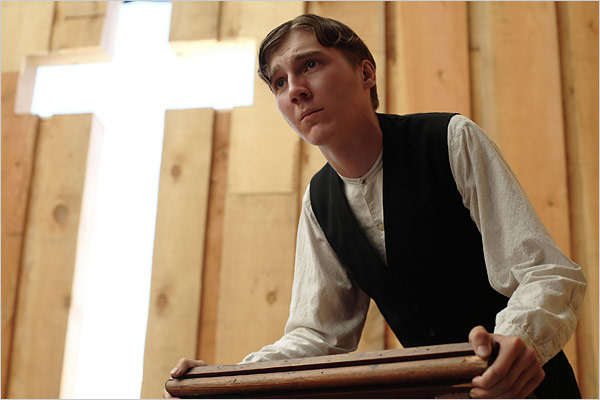 |
| Paul Dano giving a sermon as Eli Sunday in "There Will Be Blood" |
The cinematography and score were integral to the progression of the plot, as well, as both lended an eerie, macabre sense of being in the barren Texas oil fields. In all, though, it was Paul Thomas Anderson's ability to direct this epic in his usual artistically-rich fashion that encompassed all of these other elements.
In all, I loved the film - as was hopefully abundantly clear as you read the "girth" of the post! It's a definite must-see for those who love the work of Paul Thomas Anderson and/or Daniel Day-Lewis.
A+, and four stars - much like the readers of "BirdieNumNuMilkshake" (IS that catchy enough to catch on?) - you guys!
What Comes Next?
I will tell you, humble audience! The next endeavor for "BirdieNumNuMilkshake" is to delve deeper into the career of Daniel Day-Lewis via brief "character analyses" of two of his more famous characters: Daniel Plainview from "There Will Be Blood" & Abraham Lincoln from "LINCOLN (2012). As always, despite what you might think, I do welcome comments down below!
Thank you again guys, as always, for reading, and I look forward to posting (hopefully) tomorrow on the two chosen characters.
And, Twitter: Chris_0Reilly
--Chris
Tuesday, December 4, 2012
Daniel Day-Lewis Beginnings & Origin Story [ENGL 3210]
Everybody! Hello there AGAIN! I am both humbled and honored to be giving another post to you all about one of my favorite performers to ever grace this planet (or any others): Daniel Day-Lewis.
Essentially, as I have mentioned previously in other, older blog posts, to finish this Fall Semester of 2012, my English class was tasked with completing a lengthy writing assignment, of which we (the students) were to choose the topic. With this free reign, the topic I chose to explore was the careers of Daniel Day-Lewis and Peter Sellers - two actors I admire greatly. As both a performer and lover of film, I decided the optimal way to integrate these ideas was to focus on characters and films each has done by writing a film review and character analysis for each. This past week, my focus has been on Peter Sellers, and with those posts completed, my focus shifts to Daniel Day-Lewis, and his impressive-yet-brief repertoire of film.
In focusing on Day-Lewis, I then had to rigorously choose which film/character to review. As I have seen most of his films, I decided to choose from those I had seen already. Though this seemed foreboding, it was a pleasant surprise. "THERE WILL BE BLOOD" (2007) is my personal favorite film Daniel Day-Lewis has appeared in, and the integral driving force behind this decision was, conveniently, Day-Lewis' performance as the central character - Daniel Plainview. "The decision" was made, and was not even done so disrespectfully on ESPN whilst I put down a friend who had always been there for me. (LeBron James parallel!) Also, in my quest to give perspective and relevance to my blog title, I do believe I have found the way - IN "THERE WILL BE BLOOD", Daniel Plainview (Day-Lewis) exclaims "I drink your milkshake!.. I drink it UP!", hence the former half of my blog title. [SEE CLIP BELOW!]
With all of that said, I will first start with a brief "origin story" of Daniel Day-Lewis, so as to lend perspective on his performance style and reward "close readers" with trivia points of interest. YOU HAVE BEEN WARNED!.
Brief 'Origin Story' on Daniel Day-Lewis - His Early Life & Career Overview
But, I digress. Growing up, Day-Lewis was a trouble-maker, with an independent spirit and rebellious nature. He was sent away to boarding school on more than one occasion, and it was during his time spent at "Bedales Independent School" that we was able to make his first & uncredited film role in "SUNDAY, BLOODY SUNDAY" (1971) at age 14. While this provided a stimulating experience for a young Day-Lewis, his first love was wood-working. In 1975, he applied for an apprenticeship and was rejected due to lack of experience. As fallout, he applied to the British Old Vic Theatre School and was accepted; he studied there for three years, with the culmination of his hard work being performing at the Bristol Old Vic Theatre itself. Soon after his time here, he joined the Royal Shakespeare Company, and toured England for a number of years. In a 2005 interview with NYU film professor Richard Brown, Day-Lewis called this experience "tedious" and "the worst career choice I've ever made." Following his work at the RSC in the early 1980's, he accepted roles in both television and film, usually taking on small, supporting roles to gain recognition for his hard-work and application of "Method Acting" despite the smaller, supporting nature of his roles. This work paid off after his extensive research done for his role as a Czech surgeon in the 1988 film "THE UNBEARABLE LIGHTNESS OF BEING." In preparation, he learned to speak Czech, and refused to break character on and off-set during the entire 8-month shoot.
 | ||
| Daniel Day-Lewis as Christy Brown in "MY LEFT FOOT" |
This provided a springboard for Day-Lewis. However, since "MY LEFT FOOT" was made, he has only completed 10 films; during this time, he went on film-hiatus for five years, eventually being coaxed back by director Martin Scorsese and Leonardo DiCaprio to star in "GANGS OF NEW YORK" (2003). Though nominated for another Academy Award® for Best Actor, he eventually lost to Adrien Brody (who won for "THE PIANIST" (2002)).
With this background in mind, and more of a serious, "Bill the Butcher"-like tone (by virtue of the mentioning of Shakespearean acting; this adds melodrama by default), we can move on to the film review of "THERE WILL BE BLOOD" (2007).
AGAIN, thank you ALL for reading, and I will be posting again sometime within the next couple of days! Have a wonderful rest of your Tuesday, and enjoy Daniel Day-Lewis' interview with Richard Brown on "Movies 101" (the rest of the five parts are easily accessible):
Twitter: Chris_0Reilly
--Chris
Monday, December 3, 2012
Chauncey Gardner & Incidental Naming
Hello, again, everybody! "I Drink Your Milkshake & Eat Your Birdie Num-Num" has been on a roll these past few days - and the person driving the zamboni is Peter Sellers. Over the course of the past week, I have encircled Peter Sellers' life and career - from his middle class beginnings, to his serving in India & subsequently impersonating officers during World War II, to his breakout role as part of "The Goons" comedy show for BBC Radio. For those not entirely familiar with Peter Sellers, I hope to shed light on the career of the performer that has come to influence some of the brightest comedic minds of the twentieth/twenty-first centuries, including (but certainly not limited to): Eddie Murphy, Robin Williams, and Sacha Baron Cohen. I would again also like to remind you all why it is I have decided to focus not only on Mr. Sellers, but Daniel Day-Lewis on what has become to be aptly named "I Drink Your Milkshake & Eat Your Birdie Num-Num": the world of academia.
As per my own promise to my English 3210 professor, I have decided to provide character analyses, movie reviews, and insights into the lives of my two, and surely a multitude of others', greatest inspirations: Daniel Day-Lewis & Peter Sellers. While each actor's genre focus is decidedly and starkly opposite, the performance style each honed and practiced has become legendary to those who appreciate their work, and unique-but-not-necessary to those who may not. Each practiced what is known as "The Method", a term made famous through the work and curriculum of the internationally-renown and innovative theater mind Constantin Stanlislavski, a Russian theater professor. He became famous for the process of "becoming the character" via psychoanalytic character analyses, outside research, and full and unwavering commitment to the character whether actively performing (on stage or in front of a camera) or not. Famous American actors who have been known to practice this "method" include Robert De Niro, Dustin Hoffman, Al Pacino, and Marlon Brando, to name a few of the most well-known.
However, "the method," by its very nature, appealed to those artists who were shaping their own individual performance styles. As it is, an actor's need to get "into character" can happen a variety of different ways, and no one way is the "right" way or the "wrong" way. For Peter Sellers, his adherence to the Stanislavski method was never taught to him in any acting conservatory; rather, this was something he decided he needed to do in order to prepare for a film and make the character, and thus the comedy, more honest, accessible, and believable. His pension for drawing and artistry helped him to visually portray to the appropriate director how he believed his character would dress, style his/her hair, posture his/her body, and overall, create a believable world for the audience. According to Alexander Walker in his biography entitled "Peter Sellers: The Authorized Biography," the next step after the beginning sketch phase, was to find the voice of the character(s). Drawing upon his other artistic talents, he would oftentimes determine the basis of a character's cadence by giving it an accompanying musical note denotation. Also, too, each character frequently found themselves to be sharing similar vocal patterns with famous comedians/politicians/bakers he knew from "back home."
Chauncey Gardner, the principle character in Peter's final great performance & penultimate film role in "BEING THERE" (1979), found inspiration in Peter's favorite comedian from growing up: Stan Laurel. Stan Laurel was a famous British comedian who, for a time, was in the same touring vaudevillian company of a tramp, & the tramp's name was Charlie Chaplin. Not only was he in the same touring company in the early 1900's, but Stan Laurel also provided understudy support to Sir Charles Chaplin. He eventually found success, and in the mid-1910's, be-friended a portly comedian named Oliver Hardy. These two would become a formidable comedy duo in the 1920's and 1930's during the silent film era, and they made a plethora of not only shorts, but feature-length films to solidify them as comedy stalwarts of the silent era.
Stan always (literally) portrayed the understated & soft-spoken character between the two, and spoke with a deliberate, Anglo-American accent. It would be this accent, and this speaking style, that would inspire Peter Sellers in his portrayal of Chauncey Gardner in "BEING THERE." Many film historians, including Alexander Walker, and I agree that this was a fitting way to end his career: by employing the characterization that he found so much inspiration in as a young & up-and-coming performer.
Character Insight: Chauncey Gardner - "BEING THERE" (1979)
 |
| Peter Sellers as Chauncey Gardner |
It's an achievement of not only Peter Sellers, but the birth of the modern day comedy with heavily dramatic under/overtones. It showed absurdity in an utterly deadpanned, sincerely pronounced fashion, and it cannot go unnoticed that each and every one of the supporting characters helped to qualify Chauncey (whose real name is "Chance"; when he introduces himself as such to the wealthy aristocrats who take him in after an accidental injury sustained from their car, this is morphed into "Chauncey Gardner").
The premise of the film focuses on Chance, a gardner for a wealthy businessman, who has never seen the world outside of the mansion he lives in. All is taken care of for him, and all of his knowledge of this mysterious environment that lies outside of this insular world comes from the television. Additionally, too, his mannerisms and wardrobe all find their principle influence from the television. It is after this elderly man dies that Chance is forced out into the real-world, as the mansion becomes foreclosed upon by the IRS. His interactions with people are honest, despite the dialogue portraying absurdity. He often approaches people who are homeless and have less than he, saying: "I'm hungry, I'd like a grilled cheese sandwich."After days outside and living without a home, a chance (Ha ha!) encounter happens, when a limo-driver for an aristocratic family (comparable to the Vanderbilt aristocratic societal position) backs into Chance, causing a minor leg injury. Rather than bring him to a hospital, the woman in the limo (played by Shirley MacLaine) named Eve insists they drive Chance back to the estate so as to expedite treatment he could receive from the staffed medical personnel. It is in this encounter we see Chance realize the beauty of this woman, both emotionally and physically. Eventually, throughout the movie, Chance befriends the elderly man who is ill and the owner of the estate, and we as the audience eventually discover this man (played by Melvyn Douglas) is an economic advisor to the President. While initially only set to stay at the estate for a couple nights so as to heal fully, Eve shows interest in Chance, and this leads to a prolonged stay and deep friendship with Jack, the elderly man. It is in this portion of the film we, as the audience, see the satire of the (at the time; though the satire here is timeless) "modern American media," as more and more Chance's opinions are seen as legitimate and brilliant by Jack and, eventually, the President of the United States. Using gardener language, he innocently explains what he knows to the President, which eventually becomes a metaphor for the economy. Chance asserts, "As long as the roots are not severed, all is well. And all will be well in the garden." The media cannot resist Chance and his "brilliant economic ideas", and he eventually gains so much recognition as the President's chief economic adviser that he is invited to talk shows to share his wealth of ideas.
Chance's place in this film fulfills ideals of optimism and sincerity. His motivations are strictly based upon what he sees and his initial gut reaction to this based upon his experiences watching television. The character acts as a moral compass for the rest of the characters in the film.
But the characters are completely and utterly unaware of this. Herein lies the comedy.
Chance's honest conjectures at the hands of Jack and the President are mostly irrelevant to the concerned topics, as he is speaking strictly from the point of view of the everyday gardener. Despite this, his opinions are highly appreciated and even praised by the very powerful and wordly men. While this adds, too, to the comedy of the film, it also helps aid to the ever-prevalent message of individuality. Chance never wavered in expressing what he felt was right. Now, because of the character choices made previous to this, we as the audience can (accurately, I believe) surmise that he simply does not know any better, and is simply reflecting back what he viewed on television. While this is absolutely true, there is a major point of emphasis being glossed over - while Chance may not have realized what he was doing, his innocence to the situation is also then exploited by the media. This theme of further exploited innocence by the American media to go to these extenuating lengths to garner more detail simply for a story is absolutely the principle tenet of the satire. Chance as the central character, furthermore, helps to perpetuate this major thematic arc throughout the duration of the film with quips that, while seeming witty and perhaps contrived with ulterior motives to the cynical viewer, are sincere to their very core.
Because of this emotionally and intellectually rich story, Peter Sellers was pushed to his limits in portraying the dramatic moments while lacking any real emotion to any situation's consequences and stakes as a result of Chance's shallow emotional disposition. The performance of Chance was as deadpanned as one actor can be expected to portray to an audience, as the inherent disposition of Chance is a serious man.
The film's story is told methodically and beautifully through the careful direction of Hal Ashby, and the supporting performances of Shirley MacLaine and Melvyn Douglas. The music is a blend of slower melodies to help perpetuate the plot in this methodical fashion. And, of course, Peter Sellers plays Chance the gardener to a perfectly and meticulously-drawn 'T.' Overall, the film is a classic that should be some sort of required viewing for any actor having trouble straddling the "serio-comic" role.
A+, you guys.
What Comes Now?
Well, I will do my best to answer this eagerly proposed question; if you had more time, I would imagine you, as the intellectually-gifted reading audience member, would probably add an adjective/adverb or two. BUT, semantics.
Because I have exhausted the Peter Sellers portion of this project, I am now going to move on to Daniel Day-Lewis. With Mr. Day-Lewis, I will be completing the same sections - Background/Early Career, a review of my favorite film he appears in, and finally a character analysis/deeper insight into my favorite character he portrays. As I did with Peter Sellers, below are listed my top 3 Daniel Day-Lewis films and characters, in no specific order:
TOP 3 Daniel Day-Lewis Films
1.) "GANGS OF NEW YORK" (2003)
2.) "THERE WILL BE BLOOD" (2007)
3.) "LINCOLN" (2012)
**HONORABLE MENTIONS: "IN THE NAME OF THE FATHER" (1993), "LAST OF THE MOHICANS" (1992)
TOP 3 Daniel Day-Lewis Characters
1.) 'Bill the Butcher' - "GANGS OF NEW YORK" (2003)
2.) 'Daniel Plainview' - "THERE WILL BE BLOOD" (2007)
3.) 'Abraham Lincoln' - "LINCOLN" (2012)
In the week that follows, I will be reviewing "THERE WILL BE BLOOD" (2007), a film by Paul Thomas Anderson, for which Daniel Day-Lewis won the Academy-Award® for Best Leading Actor. As for my 'character analysis' post, I will be delving into his character from this film - Daniel Plainview - and his portrayal of Abraham Lincoln in "LINCOLN" (2012). "There Will Be Blood" has, thus far, been my absolute favorite film Daniel Day-Lewis has been a part of, for a plethora of reasons that I will delve deeper into as my posts continue to progress.
Again everybody, I thank you so very much for reading, and for sticking with "I Drink Your Milkshake & Eat Your Birdie Num-Num"! I promise it is a decision that will soon pay off, in a vague way that I have yet to determine................
Twitter: Chris_0Reilly
--Chris
Thursday, November 29, 2012
"THE PARTY" (1968) FULL REVIEW & Miscellaneous Other Little Discussion Topics
Hello again, all! I hope you're all having a wonderful day - a date which I have chosen to keep vague to keep myself in suspense for when I will publish this post. In this post, I will provide you, the ever-so-attentive reader, with my full review of "THE PARTY" (1968). I will be drawing upon the two biographies I have read: "Mr. Strangelove: A Biography of Peter Sellers" by Ed Sikov, and "Peter Sellers: The Authorized Biography" by Alexander Walker. Additionally, I will draw upon any relevant reviews from both the time in which the movie was released, and any done by contemporary film critics. Now, with the formal particulars taking their place in the bowels of history, here is a brief run-down of particulars and "trivia" from the film, and a background story on how it came to be made. (OH! I LOVE THOSE!)
The rest of the cast was largely an ensemble, made to complement Peter Sellers. The film was the third collaboration between director Blake Edwards and Mr. Sellers, with the previous two coming in 1963 and 1964 on "THE PINK PANTHER" & "A SHOT IN THE DARK," respectively. Each were tied to the central character of Inspector Jacques Clouseau, and the physically challenging sight-gags often executed by both Sellers & Edwards. Their partnership had been on hold, as the two had a dispute after working on "A SHOT IN THE DARK" (disputing with Sellers was often an unfortunate side-effect of working with him, and this will be explained further momentarily, educated reader.) However, the two ended up arranging a meeting in 1967, and agreed to settle the long-standing feud on conciliatory terms. Edwards was persistent in his pushing of this film and it's titular role - Hrundi V. Bakshi, an Indian film star - onto Sellers. Eventually, Peter agreed, and the movie was filmed with roughly sixty pages of a script written. Keep in mind, too, that the average movie script falls anywhere from 125-150 pages. Much of the bits included in the final cut of the film were, in fact, improvised by Peter; oftentimes, on-set brain-storming sessions between Edwards & Sellers would happen between takes.
This style of employing visually stunning & often-improvised sight gags, with little filler dialogue in between each, was inspired by the late French Academy-Award® nominated filmmaker/comedian Jacques Tati. Tati was an Academy-Award® nominated filmmaker who was known for the great emphasis he placed not on dialogue, but what are typically the italicized bits in the script: "sight gags." These are oftentimes just as wittily contrived and executed as sharp dialogue, and Tati helped to bring this aging style back to relevance in the 1950's and 1960's. Sellers was enthralled by the genius of Tati, and found much inspiration from watching the French comedian not only write and perform, but also direct all of his own films. Edwards recognized this whilst filming the "PINK PANTHER" films, and decided to branch off into a different direction, with Peter having initially thought he had exhausted the character of Inspector Clouseau (a realization that would later prove to be wrong.) Thus, Hrundi V. Bakshi was born, and "THE PARTY" became a come-back film of sorts for both Sellers and Edwards in 1968.
Now, with all of that being said, onto the actual review of the film! Whew, I'm in desperate need of an e-inhaler, if anybody has an extra, seldom-used one in their possession, I might consider buying from an Amazon customer who has been rated anywhere between 4-5 stars, with a pension for "On-time delivery!" and "THE NICEST customer service!" ... Perhaps, even "Eh... the product worked. So I suppose mediocre at best."
"THE PARTY" (1968) -- FULL REVIEW
Before I embark upon this review, I wish to clarify one thing: This review is based upon my own opinion of the film, and how I interpreted the various facets (character motivations, how filming employing various techniques helped/proved detrimental, etc.) of the film. At the review's conclusion, I'll certainly compare my own interpretation to more reputable film critics who are paid to do this for a living, and suggest you take their opinions (based on fact) much more to heart.
 |
| Sellers' 'Holy Triumvirate' of characters in "DR STRANGELOVE" (1963) |
In "The Party", the consistency and motivations of one central character are the most important facets of the understanding of the comedy. This was a concept that, to probably the majority of those viewing, might have seemed an odd & bordering on absurd concept for a Peter Sellers film. Despite achieving success for his portrayal of the bumbling, clumsy, and innocent Inspector Jacques Clouseau in the "Pink Panther" films, he had garnered a reputation for the portrayal of a multitude of characters in one film. His greatest mainstream success to that point came in 1963 when he was nominated for his first Academy-Award® for portraying President Merkin Muffley, Royal Air Force Marshall Lionel Mandrake, and the titular character & psychotic German physicist Dr. Strangelove in Stanley Kubrick's black comedy "DR. STRANGELOVE OR: HOW I LEARNED TO STOP WORRYING AND LOVE THE BOMB" (1963). He had previously played three roles in the small British film "THE MOUSE THAT ROARED" (1959). Even in other films where he was billed as one character, he would often give those characters different personas via disguises, plot twists, etc. "THE PARTY", however, was a cold pariah amongst these in a beneficial way.
 |
| Peter as Hrundi V. Bakshi |
The film centers around Hrundi V. Bakshi, an Indian film star who is as aloof as he is polite. He is accidentally placed on the guest list of a reputable movie executive's dinner party list when the movie executive hastily writes his name down on the first sheet of paper available, so as to remember to black-list him. Instead of never finding a job in Hollywood, Hrundi receives the invitation, and despite looking befuddled and flattered, does decide to venture to this gathering of the higher-ups. It is in this one setting, at the mansion of the film executive, that all - save for the opening scene on a movie set in which Hrundi, in an attempt to tie his shoe between takes, rests his foot on a detonator for a highly-funded explosion that could only be done in one take - jokes and physical comedic bits take place.
Blake Edwards - the film's director and script "developer" (as this description is truly what it was for this film: a gradual "development" of scripted material) filmed employing many panoramic shots of the inside of the mansion, with the camera acting as a sort of unacknowledged party attendee. For viewers, it feels as if though we are an intrigued observer who has noticed Hrundi, and wish to observe his actions and how they effect the group dynamic of high powered Hollywood executives. In employing this film style, Edwards gives the audience glimpses into the supporter players' lives, but never truly delves into character development of them, as previously mentioned. Rather, he gives enough information to necessitate intermittent dialogue to further the film, but relies heavily on the character of Hrundi V. Bakshi to carry the one, consistent story-line. It's a brilliantly conceived and executed idea, and it adheres to the Jacques Tati style of less dialogue and more visual focus as described above. Below is my favorite example of the visual sight gag from the film involving Hrundi & his beautifully white shoes:
The character of Hrundi V. Bakshi fits perfectly into this largely panoramic style, as it is his actions that will, and eventually do, directly effect the environment as a whole. His "black sheep"/common man character persona is the root of the comedy, as the hijinks and interactions with the otherwise lavish characters are often clumsy, but always have an innocent sincerity to them. His desire to fit in by being himself is clear from the moment he walks into the lavish mansion in his own cream-colored suit, with a tie reaching past his belt-line. His sincerity in apologizing for the gauntlet of errors
he causes at the dinner table gives the viewing audience a glimpse into the mind of Hrundi, and how he insists he apologize despite the lady of the house's (Victorian era, anybody?) insistence that he really does not have to. He does apologize to the high powered movie executive, and it is in this moment that the vulnerability reaches it's climax. And, not unlike the majority of the other moments of vulnerability in the film, it is brushed aside by the arrogance of the concerned executive. This moment could take the viewer down a variety of emotional avenues, but because of the optimism of Hrundi, his insistence to move on becomes the viewer's insistence. And, like all other moments in the film, we - the viewers and Hrundi - do.
It is because of this characterization and honest portrayal of a redeemable character that the use of brown-face on Peter Sellers does not come off as racist or offensive to me, personally. His skin is made darker, and he talks with a Punjabi-Indian accent throughout the film. To say he is mimicking Indian people is to insult the very core of Peter Sellers as a performer and vastly underestimate his talent; one could say he truly "became" an Indian person. There was never any oversimplification of stereotypes or politics by either Peter or Blake Edwards, and his portrayal was as honest as it was tedious. While there were goofy moments that seemed to perhaps hint at racial stereotypes, these were grossly outnumbered by the honest and sincere moments in which, while still keeping the humorous and accurate accent, he reached to his emotional core for dramatic moments.
In all, the performances by the supporting characters were exceptional considering the amount of leeway (or lack-thereof) they were given to effectively make a mark on the film. Because of the reasons listed above, the film is an all-time favorite of mine, too. Out of four stars, I would give it 3.5.
Looking Ahead & "What's to Come"!
As mentioned previously, my next post will be focusing on reviewing my favorite characterization of Peter Sellers and providing a thorough analysis. The character is Chauncey Gardner from the film "BEING THERE" (1979), and while Hrundi V. Bakshi was an exceptional performance by Sellers as solely one character, "BEING THERE" & Chauncey Garnder only verified his range as both a dramatic and comic actor.
Thank you so very much again, everybody, for reading and providing any subconscious feedback; I feel your presence.
Twitter: Chris_0Reilly
--Chris
Subscribe to:
Posts (Atom)